The pimple is finally gone, but the mark it left behind is still there. If you have been searching for how to get rid of acne scars, the first thing to know is that not every mark after a breakout is actually a scar. A flat brown spot, a lingering red mark, and a small dent in the skin are different problems—and they do not respond to the same treatments. Identifying which one you have can save you money, help you choose the right skincare ingredients, and keep you from irritating your skin while trying to clear it.
How to tell whether you have acne scars or dark spots
Look at both the color and texture of the mark. This is the most useful first step because products that help discoloration usually cannot fill in a deep indentation.
What your post-acne marks may be
Flat brown or gray marks
Often post-inflammatory hyperpigmentation (PIH). Extra pigment remains after the inflammation from a pimple settles. These marks can be more noticeable on medium and darker skin tones.
Flat pink or red marks
Often lingering redness after inflammation. They are not necessarily permanent scars, and the color may fade gradually.
Small dents or pits
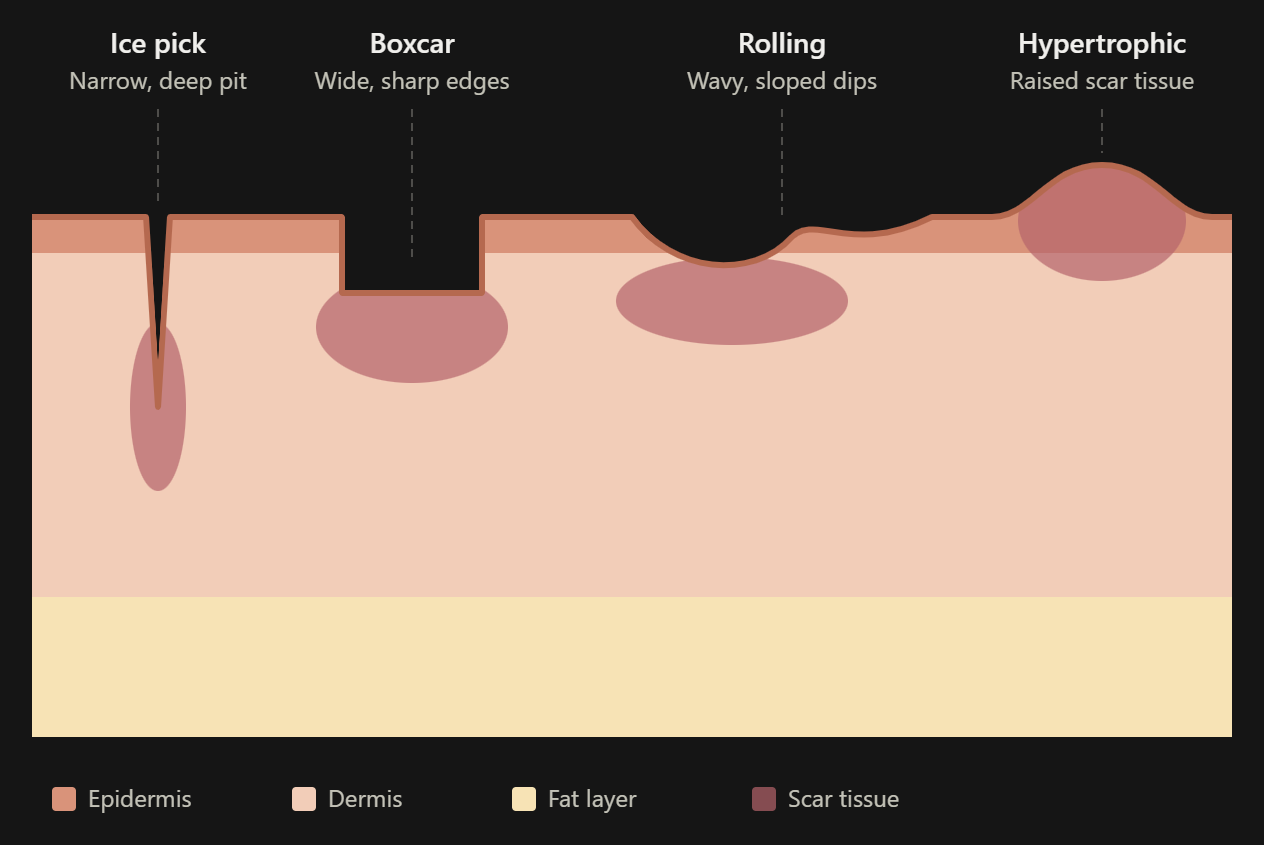
Depressed, or atrophic, acne scars. The skin has healed with a change in its structure, so a serum usually will not erase the indentation.
Raised, firm bumps
Raised acne scars can form when the skin produces excess scar tissue. A scar that grows beyond the original spot may be a keloid and should be assessed by a dermatologist.
The American Academy of Dermatology explains that flat areas of color after acne are often not scars at all. Discoloration may fade over time, while a sunken or raised scar can remain after the color changes. Read its guide to acne scar symptoms if you want to compare the main types.
A quick at-home check
In ordinary light, run a clean fingertip gently over the area without squeezing it. If the surface feels level and only the color is different, focus first on fading discoloration. If you can see or feel a lasting dip or raised area, consider a dermatologist's advice instead of buying more brightening serums.
How to get rid of dark spots after pimples
For flat post-acne marks, the goal is to prevent new inflammation, protect the skin from sunlight, and use a gentle ingredient that helps even out skin tone. There is no overnight fix. Consistent, non-irritating care is more useful than using several strong products at once.
1. Wear sunscreen every morning
Sunscreen is one of the most important steps when you are trying to fade dark spots after acne. Ultraviolet radiation can deepen discoloration, while visible light can also contribute to dark spots in some skin tones.
Choose a broad-spectrum, water-resistant sunscreen with SPF 30 or higher. Apply it generously to exposed skin and reapply about every two hours when outdoors, and after swimming or sweating. If dark spots are a major concern, a tinted sunscreen containing iron oxides may offer extra protection against visible light. Pick a formula you will actually use every day; a non-comedogenic option can be helpful if you are acne-prone.
Skipping sunscreen can make a carefully chosen dark-spot product seem as though it is not working. For more help choosing an SPF, see our guide to what SPF you really need.
2. Choose one active ingredient to start
You do not need a shelf full of serums to fade acne marks. Start with one product suited to your skin and give it time. The American Academy of Dermatology lists ingredients such as azelaic acid, retinoids, glycolic acid, kojic acid, and vitamin C among options that may help improve dark spots.
| Ingredient | Why people use it | What to keep in mind |
|---|---|---|
| Azelaic acid | Can help with acne and post-acne discoloration, making it a useful option when breakouts and dark marks happen together. | Start with a product your skin tolerates; stop if irritation is persistent. |
| Retinoids such as retinol or adapalene | Can help keep pores clear; some retinoids also improve the appearance of dark marks over time. | They can cause dryness and irritation. Introduce gradually and do not combine several strong actives at the start. Avoid topical retinoids during pregnancy unless your healthcare professional specifically advises otherwise. |
| Vitamin C | Used in brightening products to help improve the look of uneven tone. | Formulas vary. A lower-irritation product used consistently is preferable to a strong serum that stings. |
| Glycolic acid | An exfoliating alpha hydroxy acid that can help improve surface dullness and uneven tone. | Overuse can irritate skin and make discoloration harder to manage. Do not start it on the same night as a retinoid if you are new to both. |
| Kojic acid | Used in some products designed for uneven pigmentation. | Choose a reputable product and patch test; irritation can work against your goal. |
Which ingredient is best for acne scars? If your main issue is flat brown marks plus occasional breakouts, azelaic acid may be a reasonable ingredient to consider. If your main concern is ongoing clogged pores, a retinoid may be more relevant. Vitamin C is another option for uneven tone, but it is not a substitute for sunscreen. Your skin type, sensitivity, other products, and medical circumstances all matter.
3. Keep the rest of your routine simple
A basic skincare routine for acne marks should support the skin rather than leave it red, tight, or peeling. A gentle cleanser and a plain moisturizer can be just as important as the treatment product because irritation itself can contribute to discoloration.
Morning routine
- 1Wash with a gentle cleanser, or rinse with water if that works better for your skin.
- 2Apply your chosen brightening product if its directions allow morning use.
- 3Use moisturizer as needed.
- 4Finish with broad-spectrum SPF 30 or higher.
Night routine
- 1Remove sunscreen, makeup, and daily buildup with a gentle cleanser.
- 2Apply your selected treatment according to its label. If it is a retinoid, begin slowly rather than using it every night immediately.
- 3Apply moisturizer. If your skin is sensitive, moisturizer before and after a retinoid may make the routine easier to tolerate.
Introduce one new product at a time. If you start a cleanser, exfoliating toner, retinol, vitamin C serum, and acne treatment all in the same week, it becomes difficult to identify what is helping—or what is irritating your skin. Our beginner's guide to building a skincare routine explains how to keep the basics manageable.
How long do acne marks take to fade?
The timeline depends on how deep the discoloration is, your skin tone, whether new pimples keep appearing, and how much irritation or sun exposure the skin experiences. A dark spot that is only a few shades deeper than your natural skin color may take six to twelve months to fade on its own. Deeper gray or blue-gray discoloration may take longer. Appropriate treatment can help some marks fade sooner, but results are gradual rather than immediate.
A practical way to judge progress is to take a photo in similar lighting every four weeks. Looking at your skin every morning can make slow change difficult to notice. Try to assess the trend over a couple of months rather than switching products after a few days.
What if the marks look darker before they look lighter?
Do not assume that stronger exfoliation is the answer. Stinging, peeling, persistent redness, or new patches of discoloration can be signs that your routine is too irritating. Pause the product that seems to be causing the reaction and return to gentle cleansing, moisturizing, and sun protection. Seek medical advice if the reaction is severe or does not settle.
What actually helps pitted acne scars?
If you have rolling, boxcar, or ice-pick scars—indentations that change the skin's texture—an over-the-counter acne scar cream is unlikely to make them disappear. Skincare can improve the overall condition of your skin, help control new acne, and sometimes make mild scarring less noticeable. But established depressions generally need a treatment plan tailored to the type and depth of the scars.
A dermatologist may discuss options such as:
- •Microneedling, which stimulates collagen production as the skin heals.
- •Professional chemical peels, selected for your skin and scar type.
- •Laser resurfacing or other laser treatments, which can improve the appearance of some scars.
- •Subcision, fillers, or scar surgery for selected types of depressed scars.
Raised scars and keloids are treated differently; a dermatologist may consider injections, laser treatment, or other approaches. No single procedure works for every scar, and more than one session may be needed. Skin tone, acne activity, health history, cost, recovery time, and the risk of additional pigmentation should all be considered before choosing a procedure.
Avoid trying to reproduce these procedures at home. Deep chemical peels, DIY microneedling, or aggressive extraction can cause injury, infection, and more noticeable scarring or discoloration. A qualified dermatologist can help you understand what is realistic for your specific skin.
What not to do when trying to fade acne scars
It can be tempting to attack stubborn marks with the strongest product you can find. That approach often backfires, especially if your skin is already sensitive.
- •Do not pick or squeeze pimples. Picking increases inflammation and can raise the risk of scars and dark marks.
- •Do not scrub harder. Grainy scrubs and frequent exfoliation do not force a mark to fade faster; they can irritate the skin.
- •Do not use lemon juice, baking soda, toothpaste, or household bleach on your face. These are not reliable acne scar treatments and may irritate or injure skin. Never apply bleach to remove dark spots.
- •Do not add multiple strong actives at once. More products do not necessarily mean faster results.
- •Do not ignore ongoing acne. New breakouts can create new marks while you are treating old ones. Getting acne under control is part of reducing future scarring.
If you are still breaking out frequently, begin with a routine designed for acne control as well as sunscreen. Our guide to why acne happens suddenly and what you can do about it covers common triggers and treatment basics. For persistent, painful, or scarring acne, professional help is worth considering early.
When should you see a dermatologist?
Make an appointment if you have deep or painful breakouts, scars that are getting more noticeable, raised scars that continue to grow, or dark marks that are not improving despite several months of gentle, consistent care. It is also sensible to seek advice before using prescription-strength treatments or scheduling a cosmetic procedure, especially if you tend to develop dark marks after irritation.
A dermatologist can help distinguish discoloration from true scarring, treat the acne that is causing new marks, and recommend options based on your skin tone and the type of scar. You do not have to wait until acne becomes severe to ask for help.
Frequently asked questions about acne scars
Can acne scars go away on their own?
Flat red, pink, brown, or gray marks often fade gradually because they are frequently discoloration rather than permanent scars. Depressed acne scars and some raised scars are less likely to disappear on their own, although professional treatment may make them less noticeable.
What is the fastest way to get rid of dark spots after pimples?
There is no safe overnight method. Daily sunscreen, control of ongoing acne, and one well-tolerated ingredient aimed at uneven pigmentation are a sensible starting point. A dermatologist can advise whether a prescription treatment may help if the marks are persistent or widespread.
Does vitamin C remove acne scars?
Vitamin C may help improve the appearance of uneven skin tone, but it will not fill a deep pit or reliably erase every scar. For flat marks, consider it one possible part of a routine—not a replacement for sunscreen or acne control.
Is niacinamide good for acne marks?
Niacinamide is used in skincare products to support the skin barrier and improve the look of uneven tone for some people. Results depend on the formula and the individual. If the product stings or causes irritation, stop using it; a more complex routine is not automatically a better one.
Do acne scar creams work on holes or dents?
Most non-prescription creams cannot eliminate established pits or dents. Some topical treatments may make mild scarring less noticeable, but persistent textural scars are best assessed by a dermatologist who can explain procedural options and their trade-offs.
Should I exfoliate every day to fade acne marks?
No. Daily exfoliation is not necessary for everyone and may cause irritation, especially if you also use retinoids or acne medication. Start gently, follow product directions, and prioritize a healthy skin barrier and sun protection.
The bottom line
The best way to get rid of acne scars depends on what the mark actually is. Flat dark spots often respond to time, sunscreen, and carefully chosen skincare ingredients; true pitted or raised scars may need a dermatologist. Keep your routine gentle, introduce products one at a time, and treat new acne before it leaves more marks. Consistency is far more useful than trying every trending product at once.